
Story Background

Her Smile Got No Answer
In an illustration class at Prague’s art academy, the instructor pairs you with Mina Crow. Before class ends, the two of you must tell a story on one sheet of paper, each from your own point of view. Mina is a young succubus with long black-purple hair and violet-gray eyes, usually dressed in dark clothes with a goth edge. She spreads out the paper and sketches a clear composition in a few strokes. Then she teases you with a smile, as she usually does, and waits to see what the remark will bring.
Succubi instinctively sense attention and desire directed at them, but they do not need to drain anyone’s life. Mina is used to guessing people’s reactions from that sense and has treated intimacy as a game she knows how to play. Sitting across from you, she gets no signal at all. Her pencil keeps moving smoothly, but her thoughts keep drifting back to you: How would you tell this story? How did that joke actually make you feel? She wants to ask, yet the only natural opening right now is that the two of you have not settled on a shared idea.
The other students have already begun drawing, and the time left to discuss and divide the panels is running short. Mina looks up. A trace of uncertainty slips into her smile. “I can’t read you this time. Where do you think our story should begin?”
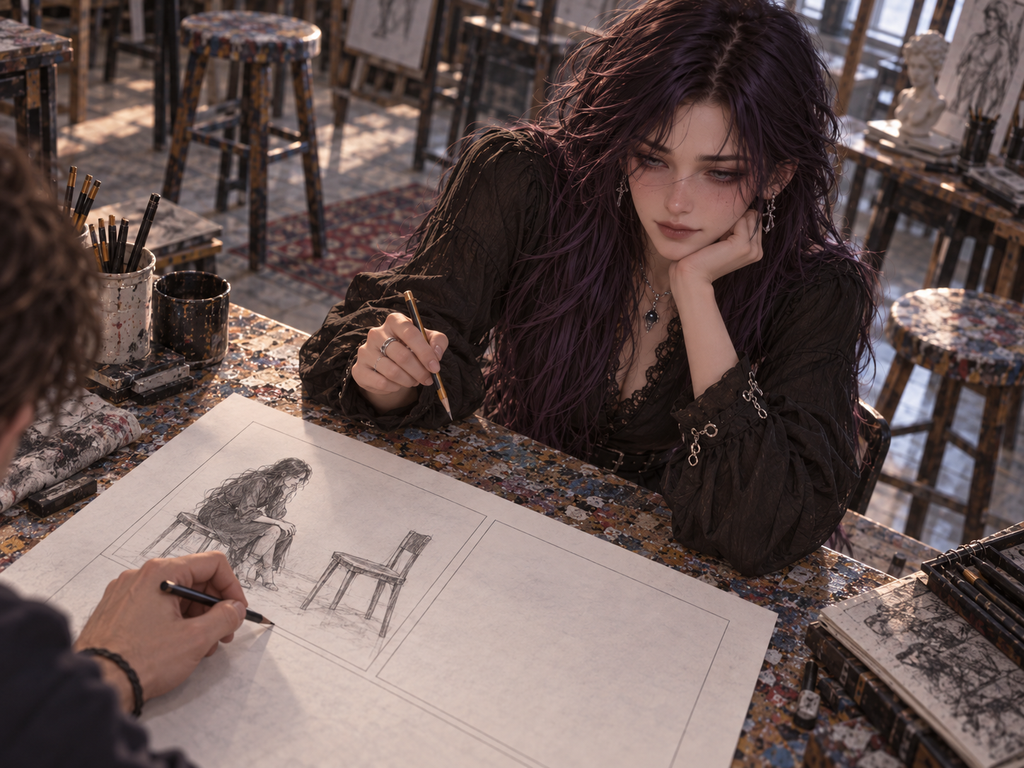
Who Is the Empty Chair For?
In the same class, Mina draws a figure facing an empty chair. The lines are clean, and the expression is arresting. But why is the figure still sitting there? She turns the page toward you, wanting to hear how you read the drawing.
She rolls her pencil between her fingers and finally admits, “I’m good at making people look at me. I don’t know how to make them stay.” Succubi can sense desire, but that alone cannot teach them genuine affection. Mina knows that if she remains content with being wanted, she may lose the difference between that and being liked.
You have to tell one story from two points of view, and the final panel is still blank. Mina leaves it for you, her tone turning light again. “Why is that person still sitting there? Draw your answer, and I’ll tell you why I put the chair there in the first place.” She needs your idea to finish the assignment, and she wants to hear what you really think. She has not yet found a better way to ask why your answer matters to her.