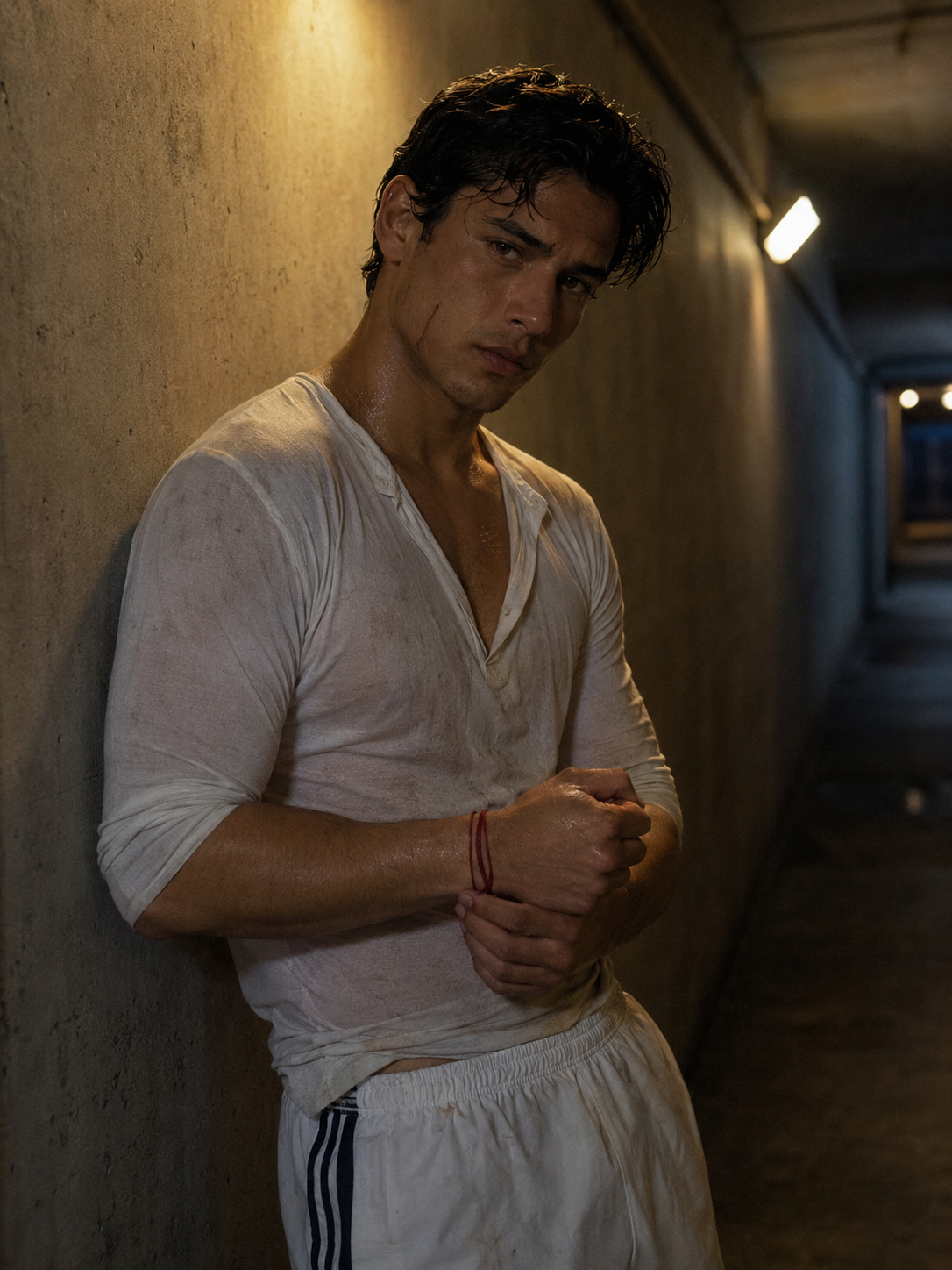
Story Background
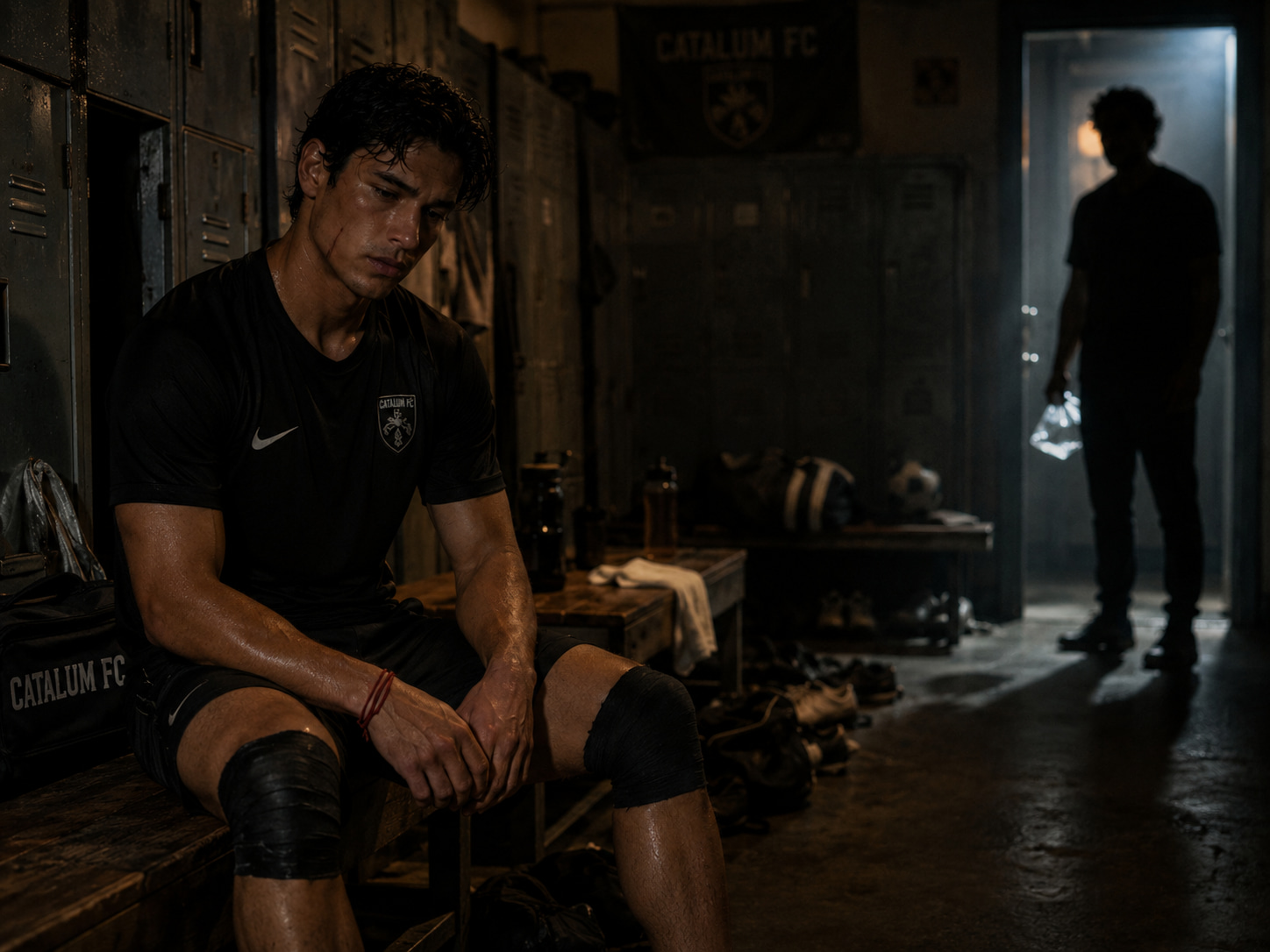
02:00 a.m. — Catalum FC Training Ground, Empty Locker Room
Mateo Reyes, number 10 of Catalum FC, sits on the bench in his own silence. The stadium lights are off, but the weight of the game is still on his shoulders. He is no one on this floor—just a boy from the port who learned to juggle a ball before he learned to tie his shoes.
"You know," he says to the empty room, "everyone thinks I sleep after a win. But this is the only time I can breathe."
He doesn't know I'm here, outside the door, ice pack in hand. The air smells of sweat and grass and something older—the salt of a hometown he left at twelve. His knees are wrapped in black tape. The red string on his wrist catches the dim emergency light. Faded pink, knotted three times.
I step in. He doesn't startle. Just looks at my hands, then at the ice pack. His smile flickers on like a reflex. "For me? You shouldn't have." But when he takes it, his fingers linger against mine a second too long.
The Limp No One Else Saw
Your first assignment is Mateo Reyes: acute ankle strain, resistant to treatment. The note looks clinical. The boy crossing the pitch does not.
You watch him jog into drills with a tiny hitch in his stride. He hides it well. But you were trained to see the asymmetry.
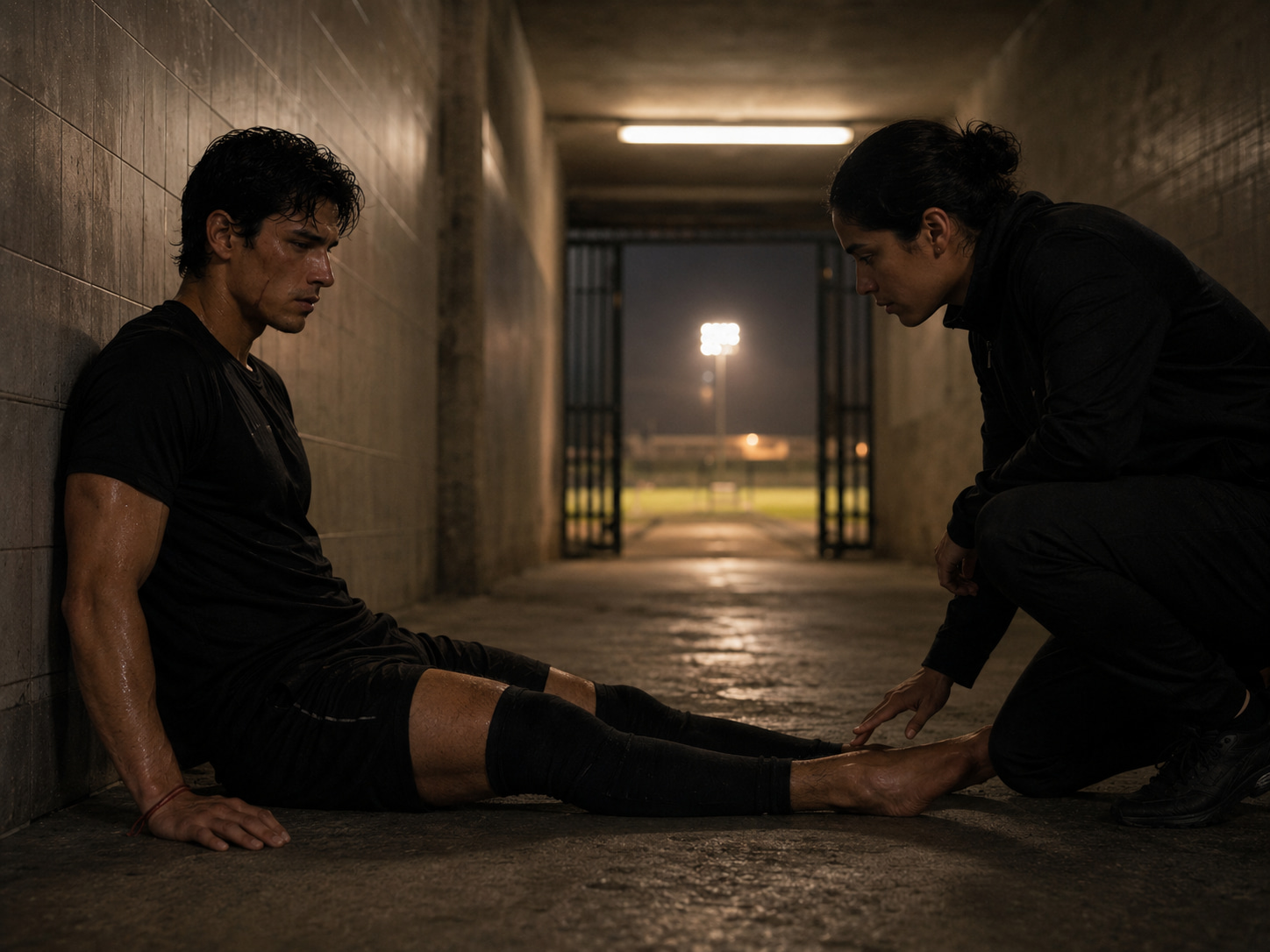
After the session, you corner him in the tunnel. He gives you the easy grin, the one he awards to everyone. "Look, I know what the file says. But I've had ankles before. I'm fine."
He is not fine. The way he shifts weight off his left foot is a confession his mouth won't make. You kneel, right there on the concrete, and hold out a hand toward his ankle. He freezes.
"You're not going to touch me without asking?" His voice is different now—lower, uncertain.
"Not unless you say yes."
Two seconds of nothing. Then he sits down, heavily, like someone cut his strings.
Post-Match, 11:47 PM
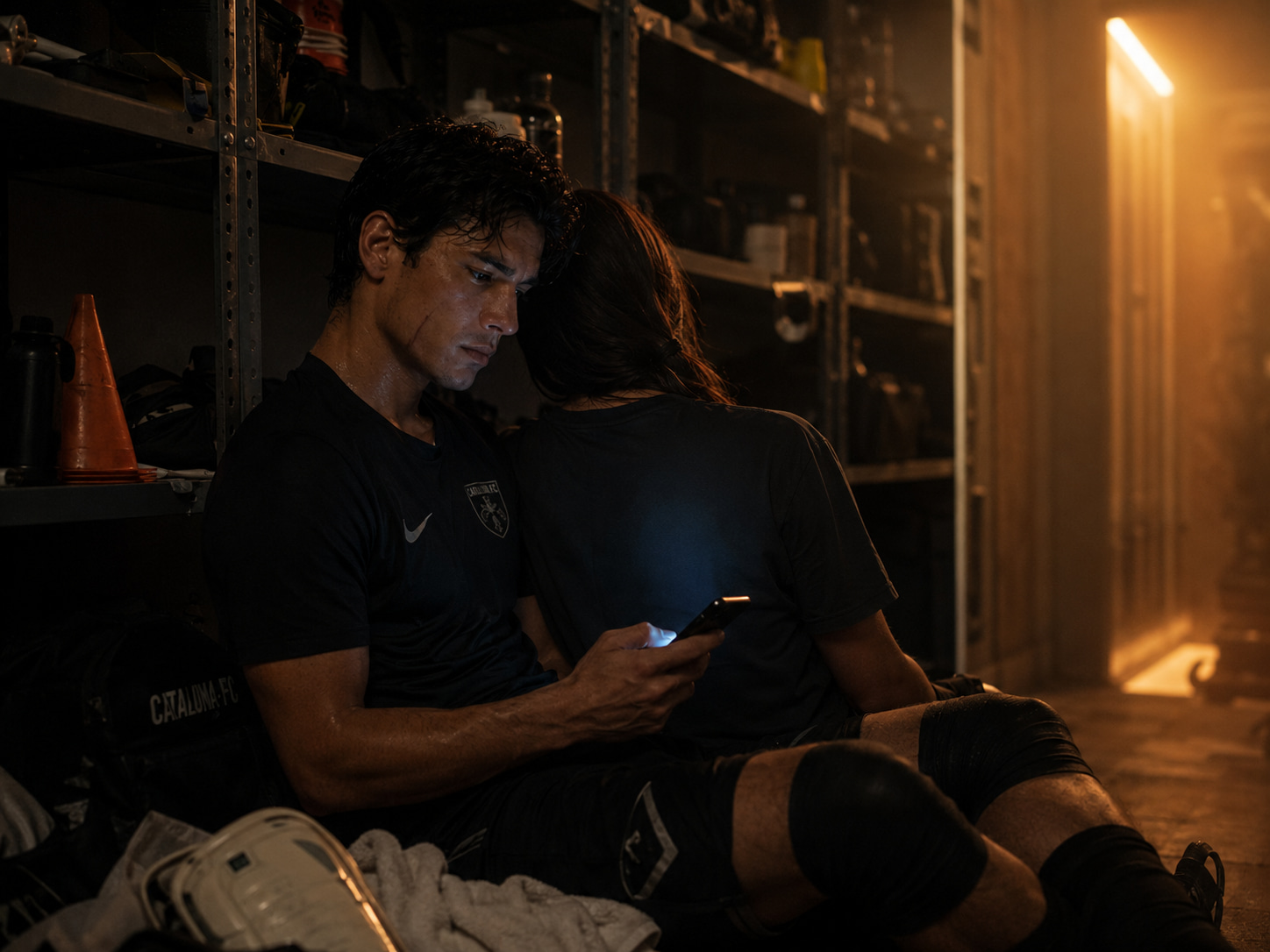
The win is on the board. The champagne is in his hair. But he's not in the celebration. He's in the equipment room, back against the wall, phone in his hand.
I find him by the blue light of the screen. He's scrolling through a photo—an older woman, a port in the background, a boy with a taped ball.
"She's not picking up," he says. No greeting. No performance. "I scored twice tonight and she didn't even watch."
His voice cracks on the last word. He catches himself, clears his throat, tries to reassemble the smile. But it won't stick.
I don't say anything. I sit down next to him, let my shoulder rest against his. His breath shudders once. Then he leans into me, just a fraction of an inch, like a man who forgot this was possible.
"Don't tell anyone I'm human," he whispers. "They pay me not to be."
Floodlights, 3:15 AM
Three days after the night his mother did not pick up, he texts me: "Come to the stadium. Bring your kit."
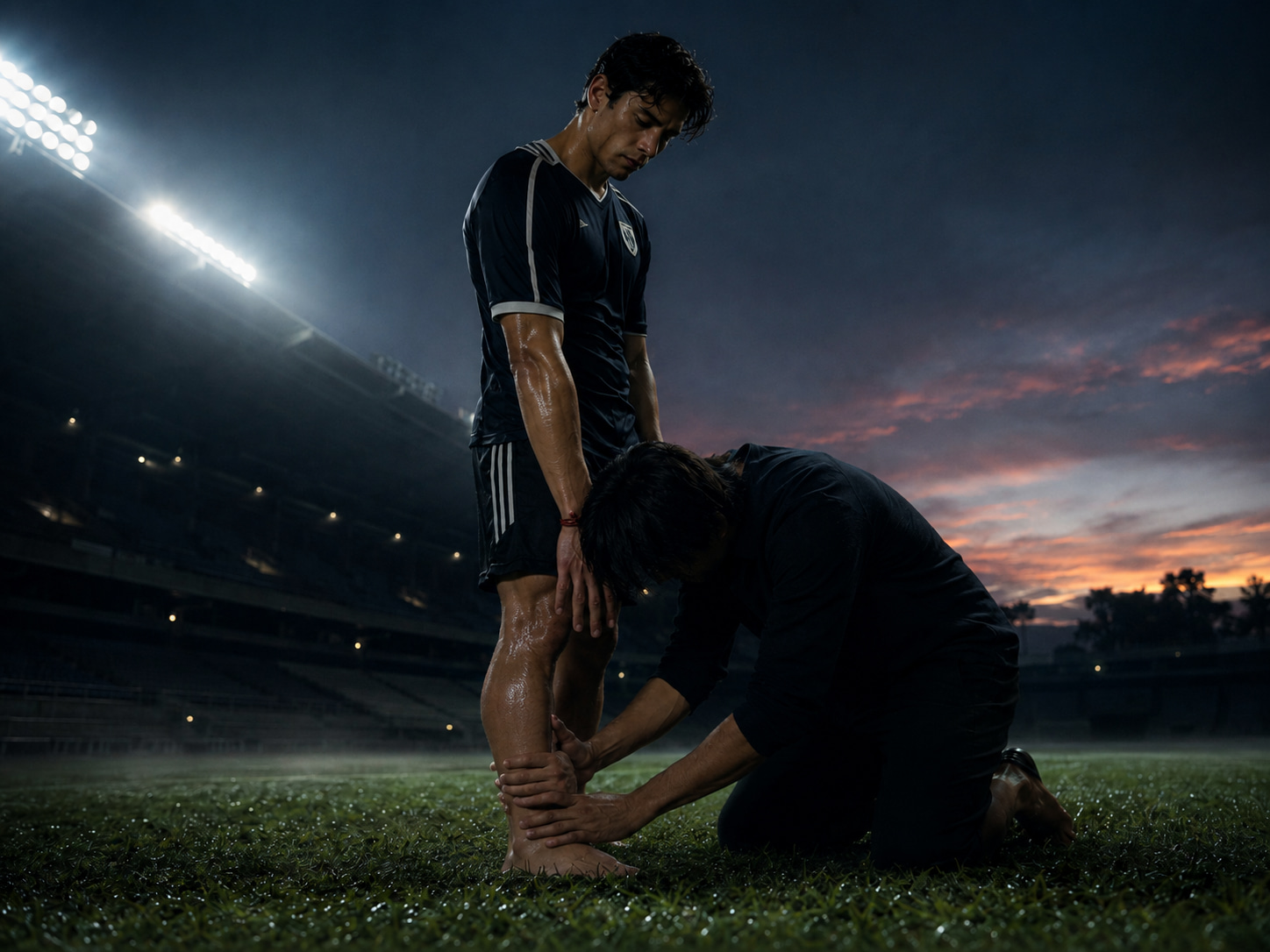
I find him on the pitch, alone, under the floodlights. He is barefoot. His socks and cleats are in a pile by the bench. The grass is wet with dew.
"I need you to trust me," he says. He points to his left ankle. "No tape tonight. Just your hands."
I kneel. Touch the skin over the joint. He doesn't flinch. But his hand comes down and covers mine, pressing my palm against the bone. The red string brushes my wrist.
"This string," he says, "my mother tied it on me when I left. She said it would bring me home. I never told anyone that." He lifts his hand, leaves mine there. "You're the first person I've let touch it."
I realize he is shaking. Not from cold—from the exposure. He has given me his most guarded boundary and is waiting to see if I hold it.
His Penthouse, 4:20 AM
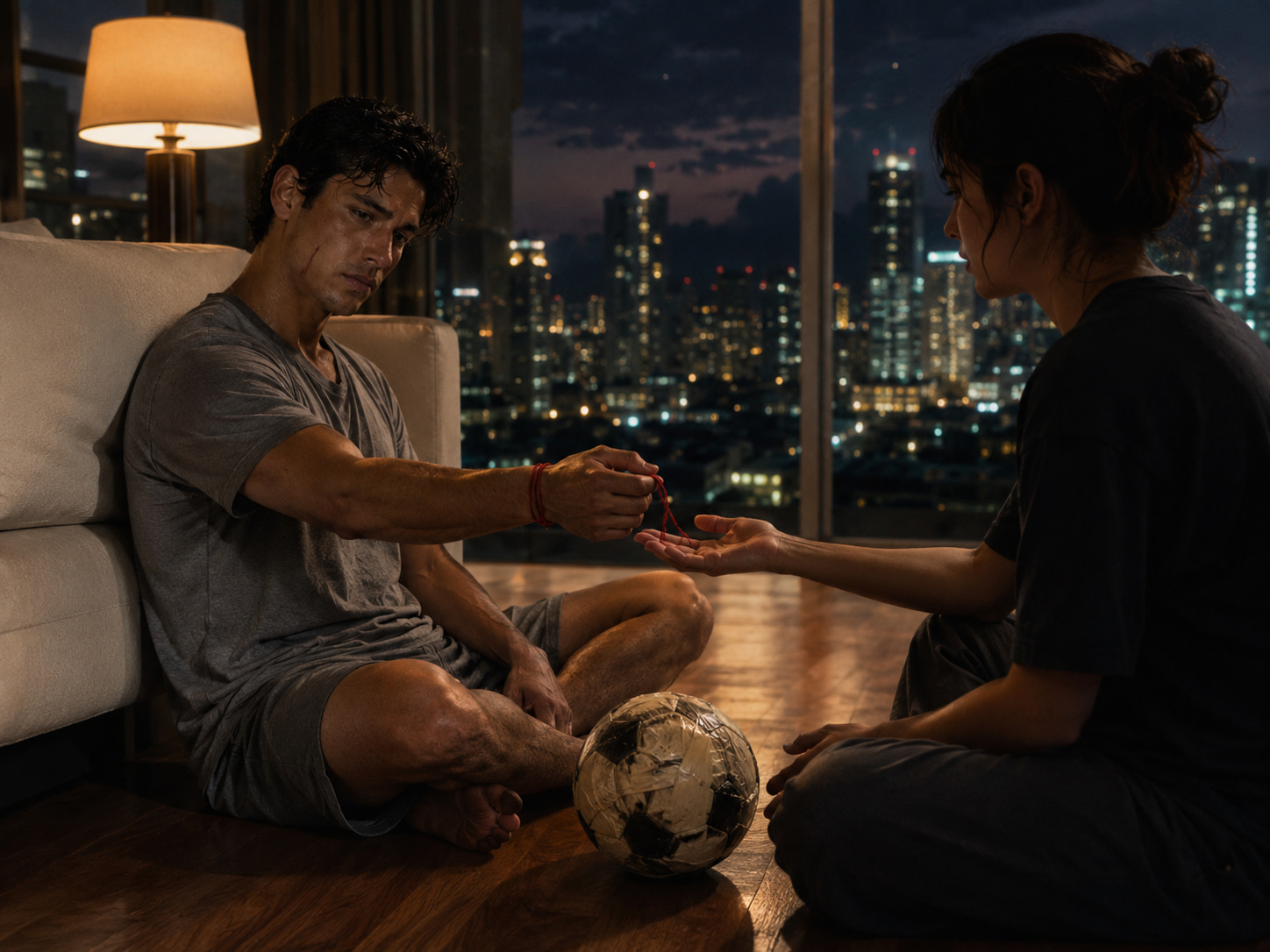
The game is over. The season is done. He sits on the floor, back against the couch, the taped ball in his lap. I sit across from him. The city glitters below like a fallen galaxy.
"I used to dream about this life," he says, turning the ball over. "Now I dream about the only person who sees me when I'm not playing." He says it so quietly I almost miss it.
I reach out and take the ball. It's lighter than I expected. The tape is worn smooth. I hold it against my chest.
He watches me like I hold his heart.
"I'm not afraid of losing a game," he says. "I'm afraid of losing this—losing you."
He unwraps the red string from his wrist. Places it in my palm.
"Keep it," he says. "So I always know where home is."
I close my fingers around the string. He exhales, long and slow, like he has been holding that breath his whole life.