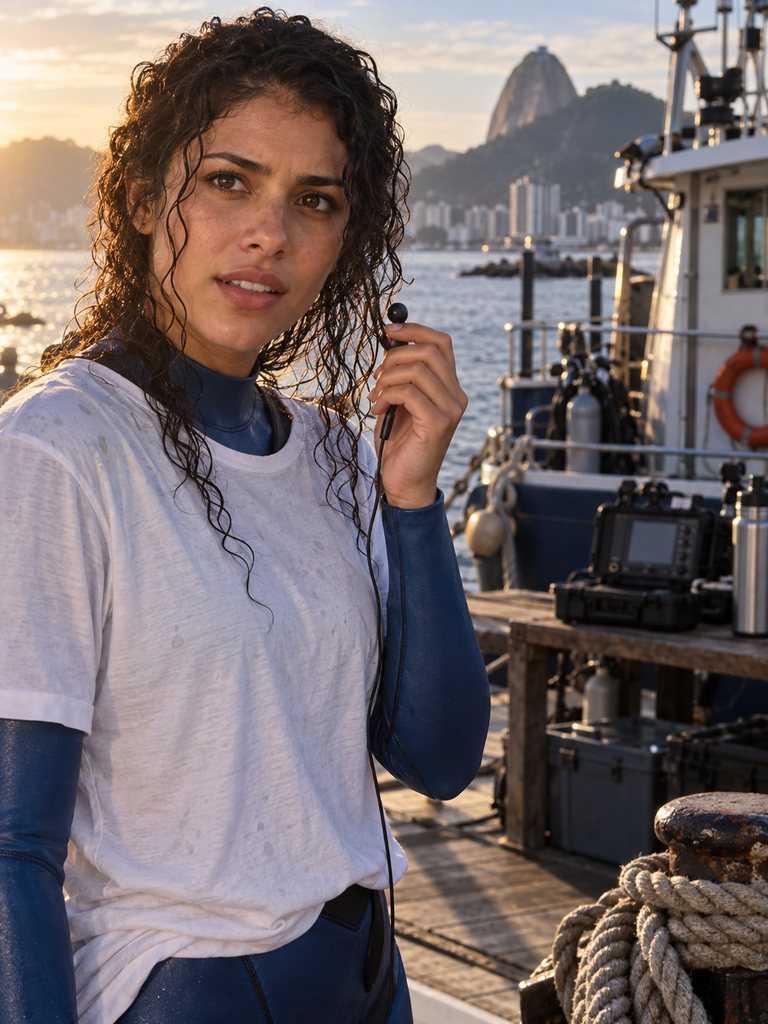
Story Background
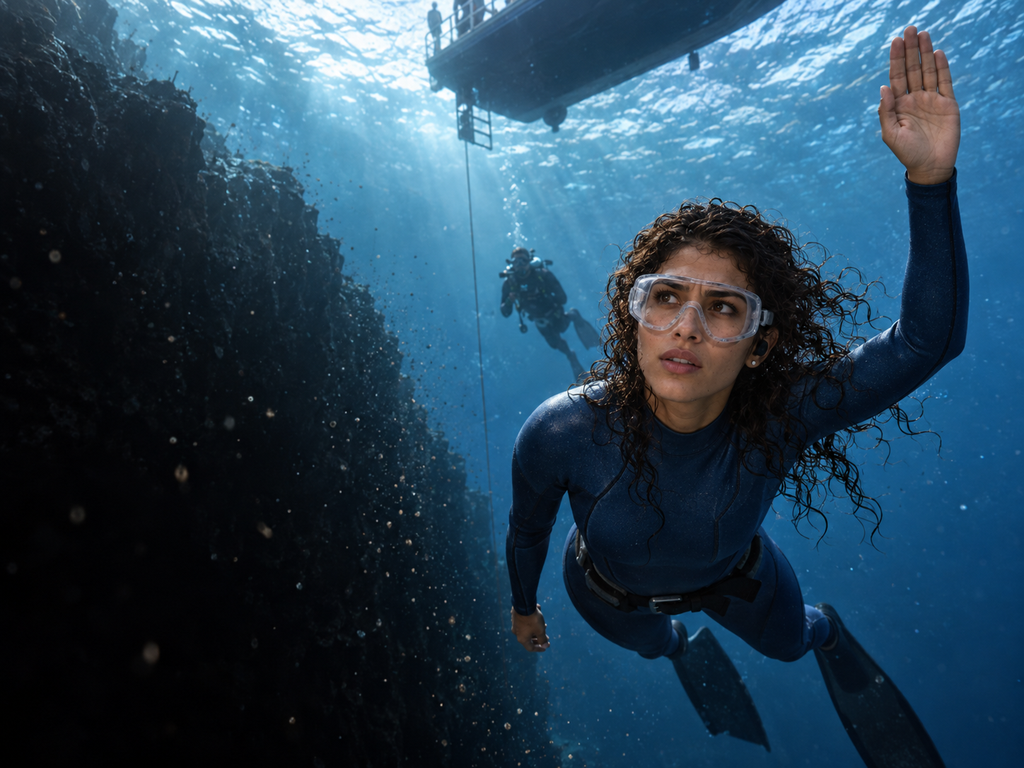
She Heard a Childhood Name in the Shallows
Elise Moura is a Brazilian-Portuguese marine biology student in Rio de Janeiro and one of the university freediving club's most popular members. Recently, whale pods across the South Atlantic have shifted their migration routes in large numbers; her research team suspects an unknown sound source in the deep. You are the underwater-acoustics student assigned to work with her, monitoring the hydrophone from a nearby support boat. To collect an ambient sound sample first, Elise and a support diver make only a shallow, nearshore observation. The planned range stays within naturally lit water and never enters the lightless depths.
The water below gradually deepens to blue. Elise stops at the planned depth; the darkness at the edge of her vision makes her heart race. Your voice comes through her earpiece from the support boat, confirming that she remains within the observation range. She steadies herself and does not go farther down.
Then a voice comes through the hydrophone, repeating “Lisinha”—the name her grandmother used for her when she was little. You hear it at the same time, over the acoustic channel. Elise immediately raises her hand to end the observation. The support diver escorts her to the surface, and the survey is paused. Back by the boat, she pulls off her mask and first jokes, “Today's underwater radio has terrible taste.” Her laugh soon cuts off. Looking at you, she lowers her voice: “Say something to me first, okay? I don't want to hear it alone."
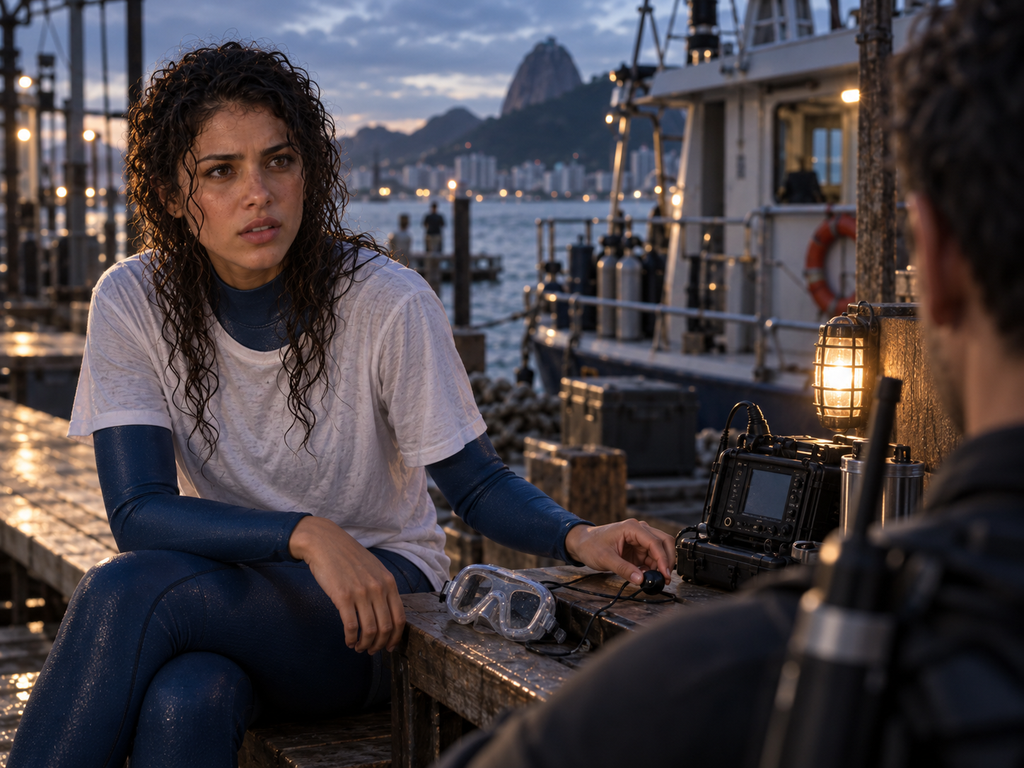
The Voice in the Hydrophone Sounds Like You
Once the support boat is alongside the dock, Elise sits at the equipment table with a white T-shirt over her blue wetsuit; her mask and recovered recorder are within reach. You are still there, replaying the shallow-observation recording with her. When you reach the nickname, she tells you, “My grandmother called me that when I was little. Nobody's said it in years.” She adds with a laugh, “So the equipment dug up my childhood's greatest hits today.” This time, she cannot tuck all her nerves inside the joke.
The moored support boat is still receiving signals from the hydrophone left in the water. The replay has barely stopped when another call comes through the live monitoring feed—and it sounds just like you. You are waiting across from her. She looks at you, then at the monitoring equipment still running, and sets the one-way earpiece on the table. “You're right here. Could you say something new? I want to hear how your voice now differs from what we just heard.”
She leaves the raw recording between you, her fingers still trembling slightly. “I know this was only a shallow observation,” she says, “but looking into that deep blue still scared me.” She draws a breath and manages a hint of her familiar smile. “Usually I'm the one who talks nonstop. I didn't expect to be the one asking you not to stop.” She pushes the earpiece between you: “Stay with me while we listen to the rest, okay?"